
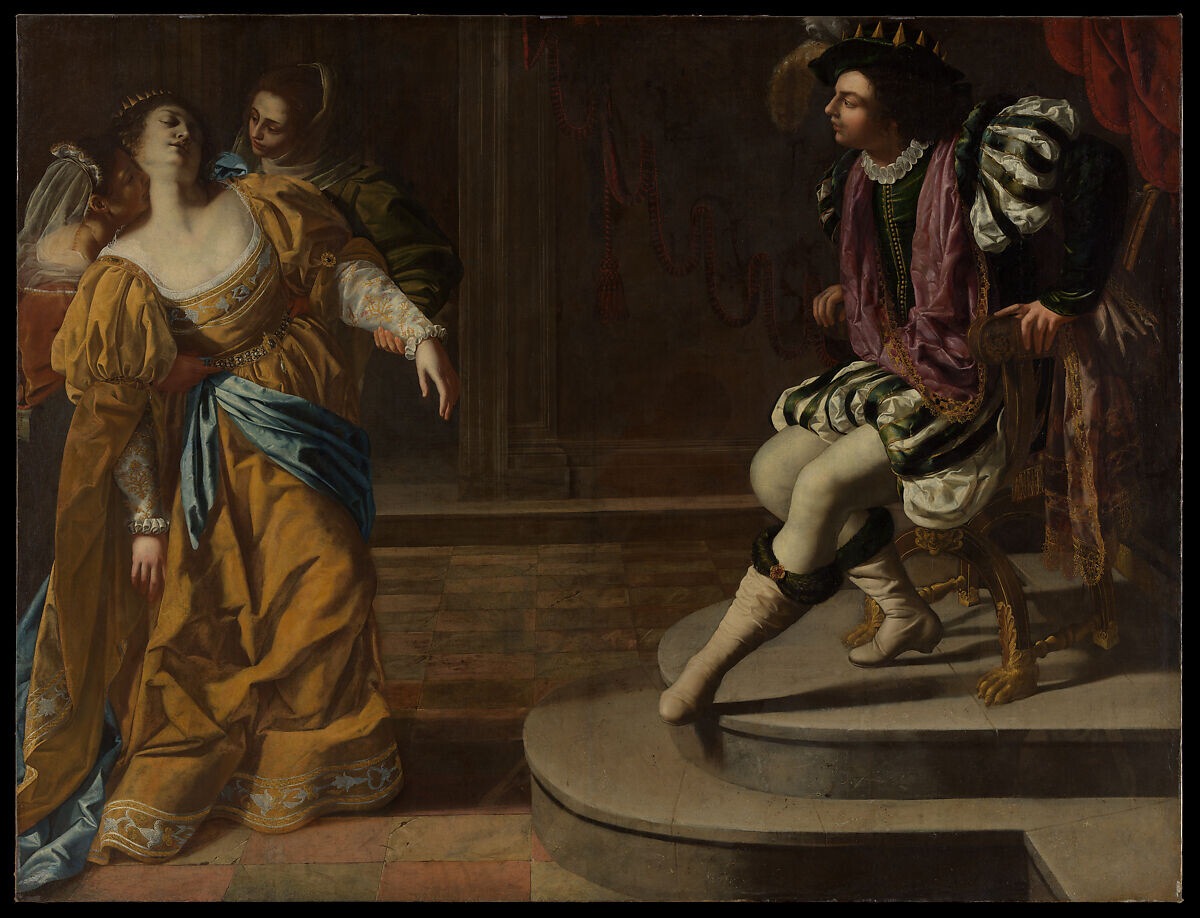
At first, the painting appears divided in two. Esther collapses into the arms of her attendants on the left. King Ahasuerus leans forward from his throne on the right. Between them lies a broad strip of marble floor — an interval that feels less like empty space than suspended time. Artemisia Gentileschi makes that pause carry the danger of the entire story.
The most dangerous step
Esther enters the king’s presence without being summoned. In the story, that breach of court protocol can be punished by death. She accepts the risk to prevent a planned massacre of her people.
Gentileschi chooses the instant when courage becomes physically costly. Esther is not shown delivering a polished speech or celebrating victory. Her colour drains; her body gives way. Two attendants catch her before she reaches the floor. The painting therefore refuses a simple equation between bravery and invulnerability. Esther acts while fully exposed to fear.
Ahasuerus has not yet crossed the room. His body pitches forward, one hand opening in alarm, but the outcome still hangs between impulse and action. We know that he will grant Esther’s request. The canvas makes us wait as if we do not.
What the empty space does
The widest and quietest part of the composition is the gap between Esther and the king. It separates vulnerability from authority, appeal from judgement, and private resolve from public consequence.
Gentileschi strengthens the interval with a checkerboard pavement that pulls the eye into depth. The diagonals point towards the king, yet Esther’s pale dress and illuminated face hold us on the opposite side. Vision moves across the floor, then back again. That visual hesitation is the painting’s emotional rhythm.
The drama is not only in the figures. It is in the distance that one of them must choose to cross.
The large format intensifies the effect. At more than two metres high and nearly 2.74 metres wide, the painting surrounds the viewer with courtly scale while keeping the human crisis immediately legible.
A biblical story in contemporary dress
The Met notes that Gentileschi did not aim for archaeological reconstruction. Contemporary theatre helped shape the scene. Esther and Ahasuerus wear the sumptuous clothes of the painter’s own world: layered fabric, plumes, silk stockings and sharply staged gestures.
That choice brings the story closer. The king is not a distant emblem cut from ancient history; he is a young ruler performing magnificence. Esther is not reduced to an abstract model of virtue. She is a believable woman using intelligence, presence and extraordinary nerve inside a system in which the decision belongs to someone else.
Gentileschi had built an international career across Rome, Florence, Venice, Naples and London. Here, ambition is visible not as biography pasted onto the work, but as control of scale, costume, movement and narrative timing.
The figure beneath the floor
The painting also preserves evidence of revision. The Met records that Gentileschi painted out a servant of African descent restraining a dog near the centre of the composition. As the upper paint layers have become more transparent, parts of those forms can be detected beneath the marble pavement to the left of the king’s knee.
This is not a secret message waiting for invention. It is practical evidence of an artist reconsidering the balance of a difficult scene. Removing the pair cleared the visual interval between Esther and Ahasuerus. The revision gives the pause more force — and reminds us that apparent emptiness may be the result of active, deliberate editing.
Anima Liriana view
Gentileschi’s Esther is powerful because the painting does not pretend power is easy. Her body falters, her purpose does not. The king occupies the throne, but Esther determines the moral direction of the scene.
The lasting image is not a triumphant pose. It is the charged space before the answer: one woman has already crossed the forbidden threshold, and authority has only just begun to move.
SOURCES & IMAGE STATUS
The exact image used is marked Public Domain on The Met object page and supplied through The Met Open Access programme for unrestricted commercial and noncommercial reuse under CC0. Object data, dimensions and interpretive facts were cross-checked against The Met’s current collection record and curatorial essay on 16 August 2026. No modern exhibition or press photography is reproduced.