
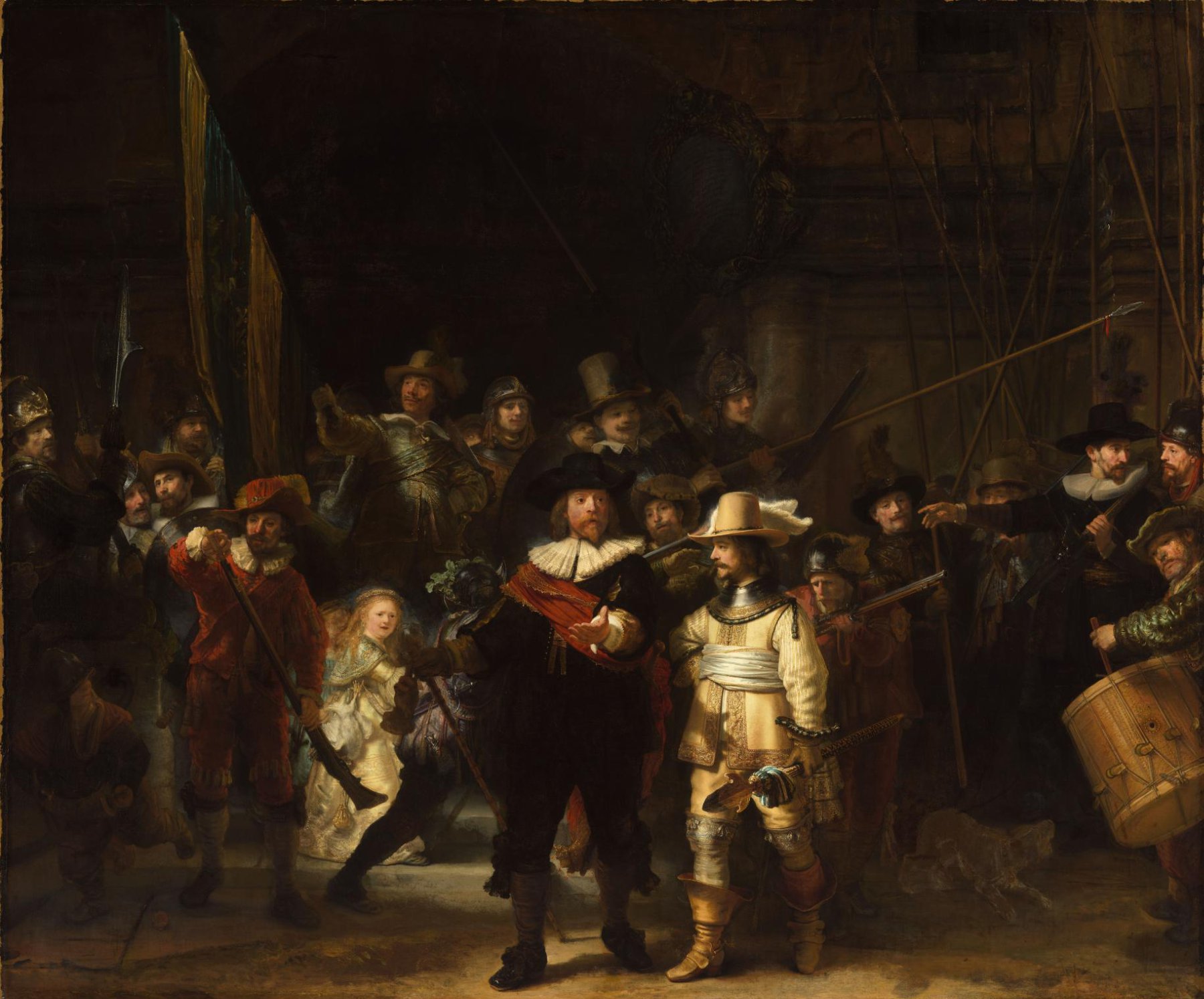
The Night Watch has survived nearly four centuries, repeated moves, changes in display, earlier treatments and deliberate attacks. Its fame makes every intervention consequential. That is why the Rijksmuseum began Operation Night Watch in 2019 as an unusually open programme of research and conservation, conducted in a glass chamber before the public.
A public operation
Before treatment began, specialists spent five years documenting the painting and studying its materials. The project combines the judgement of conservators with imaging, chemical analysis and data gathered across the full surface.
In November 2024, a team of eight conservators began removing the old varnish with microscopic precision. The goal is preservation, not spectacle: the process must respect Rembrandt’s paint while gradually separating later material from the original surface.
Beneath the surface
The project’s ultra-high-resolution image is assembled from 8,439 photographs. At 717 gigapixels, it allows researchers to examine paint at a scale smaller than a human red blood cell. Close looking turns familiar passages into landscapes of pigment, brushwork and ageing material.
At this scale, “dark” is no longer one colour. It becomes a record of pigments, varnishes, abrasion, old retouching and Rembrandt’s decisions.
Scientific analysis also revealed a lead-containing impregnation beneath the ground layer. Rembrandt appears to have used it to help protect the enormous canvas from moisture on the wall for which it was commissioned — an inventive preparation not previously observed in his work.
Holding the canvas
Not every problem sits on the painted surface. Uneven tension had created deformations, particularly in the upper-left corner. In 2022, the canvas was removed from its 1975 wooden stretcher — and from 564 tacks — so the structure could be treated and the painting mounted on a new aluminium stretcher.
This kind of work is visually quiet but fundamental. A painting of this scale is also a physical object: canvas, weight, tension and movement must remain in balance if the image is to survive.
What restoration reveals
The most important “after” is not necessarily a dramatic transformation. It may be a safer support, a more legible relationship between colours, or a clearer distinction between Rembrandt’s hand and the history that accumulated above it.
Operation Night Watch is still in progress. It should not be described as a completed makeover. What it offers now is more valuable: a rare view of how evidence, patience and restraint protect a masterpiece without pretending that time never touched it.
SOURCES & IMAGE STATUS
Artwork: Rembrandt van Rijn, The Night Watch, 1642, oil on canvas, Rijksmuseum, Amsterdam. Object SK-C-5. Public domain.
Research: Rijksmuseum’s official Operation Night Watch project pages, collection record and press releases.
Explore Operation Night Watch at the Rijksmuseum ↗