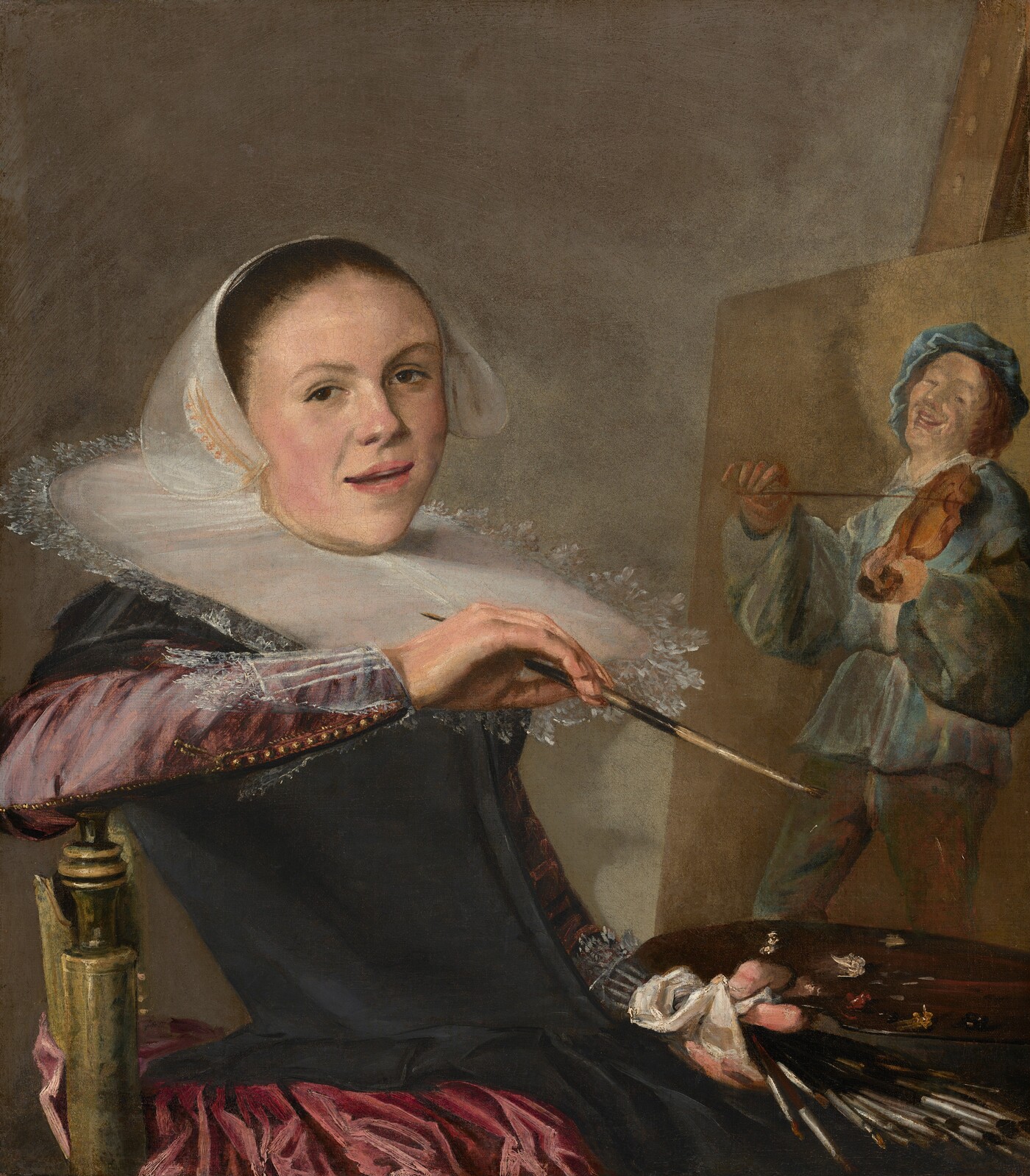
Judith Leyster does not present herself as a silent ornament. She turns from the easel as if interrupted mid-stroke, one hand lifting a brush while the other grips a palette, a cloth and a bristling fan of tools. Her smile is open, almost conversational. The message is unmistakable: this is a working artist, and she knows exactly what she can do.
A portrait that performs
Painted around 1630, when Leyster was about twenty or twenty-one, the Self-Portrait is oil on canvas and measures 74.6 × 65.1 cm. It belongs to the National Gallery of Art in Washington.
The painting behaves like a compact advertisement for Leyster’s range. The stiff white ruff and richly handled sleeve demonstrate her command of translucent lace, velvet and reflected light. The violinist on the canvas behind her points to the lively musical and genre scenes for which she was known. The visible abundance of brushes turns equipment into evidence: she has not merely posed as a painter; she has staged the profession itself.
The pose feels spontaneous, but it is carefully engineered. Leyster leans back across the chair, creating a diagonal that gives the image its movement. Her raised brush answers the violinist’s bow. Two acts of performance — painting and music — meet in a single rhythm.
Why the smile matters
Professional women painters were unusual in the Dutch Republic, though not absent. Leyster entered Haarlem’s Guild of Saint Luke in 1633 and later ran a workshop with students. Her ease before the viewer is therefore not a decorative detail. It is authority delivered without stiffness.
For centuries, parts of her reputation were obscured by misattributions to male contemporaries, including Frans Hals. The modern recovery of her authorship changes the portrait again: what once looked like charm now also reads as self-definition.
Anima Liriana view
Leyster’s power is not borrowed from costume or solemnity. It comes from motion. She lets us see the work beginning, not only the finished result. Four centuries later, that remains one of the most convincing ways an artist can say: I belong here.
SOURCES & IMAGE STATUS
Public domain. The National Gallery of Art explicitly marks the object media free and in the public domain. Checked 26 July 2026.