The restored Lamb at the centre of the Ghent Altarpiece looks directly outward with large, frontal eyes. When the image returned to public view, many people assumed conservators had made it strange. The evidence says the opposite: restoration removed a later intervention and revealed the earlier design.
What the conservators found
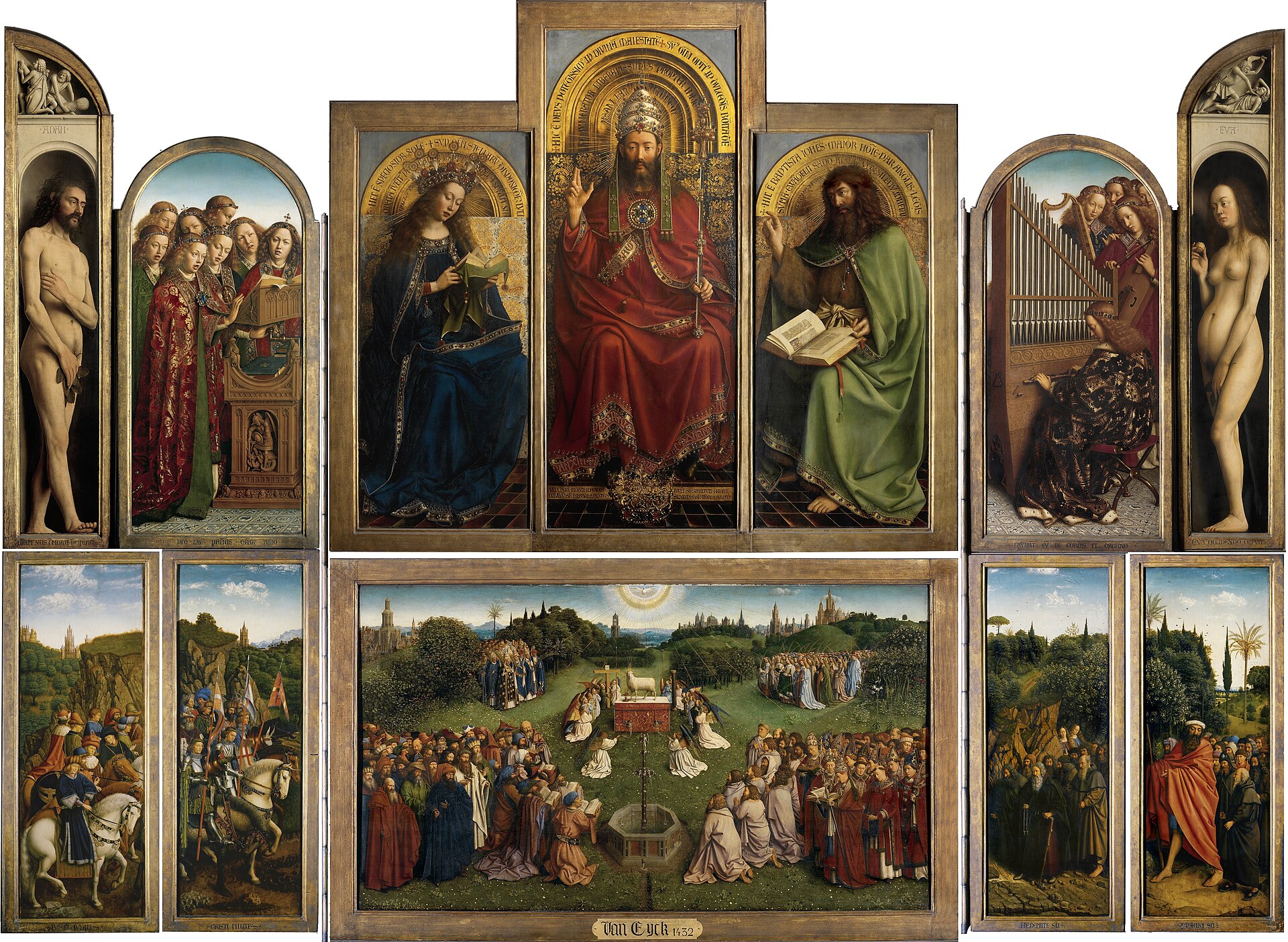
Completed in 1432 by Hubert and Jan van Eyck, the Ghent Altarpiece is a monumental polyptych in Saint Bavo’s Cathedral. Centuries of dirt, yellowed varnish, repainting, movement and wartime storage had altered its appearance.
The Royal Institute for Cultural Heritage reports that extensive later repainting covered parts of the work. During treatment of the lower interior panels, conservators removed discoloured varnish and overpaint where analysis showed it could be done safely.
On the central panel, later paint had changed the Lamb’s head. The restored original has more frontal eyes and a stronger, almost human encounter with the viewer.
Before and after
Before: the Lamb’s later face appeared more conventionally animal-like. Its gaze was gentler and less direct. Layers of varnish and intervention reduced clarity across the surrounding scene.
After: the earlier head is visually concentrated. The eyes meet the viewer, reinforcing the Lamb’s symbolic role as Christ rather than as a naturalistic farm animal. The face moves deliberately away from ordinary zoology toward theology.
What restoration actually means
Good restoration is not a beauty filter. It is a chain of research decisions: imaging, material analysis, microscopic examination, testing, documentation, ethical review and extremely controlled removal.
The goal is not to make an old picture look new. It is to understand which historical layer belongs to which moment — and what can be uncovered without sacrificing original material.
Familiarity can make a later alteration feel original. Evidence sometimes returns a work in a form that looks less comfortable — and more truthful.
Anima Liriana view
This article deliberately uses only a public-domain reproduction of the altarpiece. Modern restoration photographs are linked through the official research projects but are not reproduced because their commercial reuse terms were not explicit enough.
SOURCES & IMAGE STATUS
Only a faithful reproduction of the public-domain artwork is used. Modern KIK-IRPA and MSK restoration photographs are linked but not reproduced. Checked 26 July 2026.